Get Started with CardioWave
Examples of basic useage
Prepare a CSV table like this format:
compound |
concentration |
well |
plate |
..others.. |
time |
signal |
|---|---|---|---|---|---|---|
CP1 |
0.1 |
A1 |
P1 |
… |
0 |
1000 |
CP1 |
0.1 |
A1 |
P1 |
… |
0.33 |
1001 |
… |
… |
… |
… |
… |
… |
… |
CP2 |
0.1 |
A2 |
P1 |
… |
0 |
1000 |
… |
… |
… |
… |
… |
… |
… |
The order of the rows and columns do not need to be fixed but the column names must be exactly the same to the required (e.g. lowercase). The following columns are compursory: ‘plate’, ‘compound’, ‘concentration’, ‘well’, ‘time’, ‘signal’. Optional columns include ‘cpid’ (compound ID) and ‘vendor’. Other columns will not be used.
import pandas as pd
from cdwave import data
from cdwave import derive

# Load and convert
df = pd.read_csv('data.csv')
loader = data.StandardCSVLoader(data=df)
dataset = loader.transfer()

# Calculate parameters
derive.calc_parameters_for_waveforms(dataset)
dataset.save('data.pickle.gz')

# Export parameters
parameter_df = dataset.get_parameter_df()
parameter_df.to_csv(os.path.join(data_path, 'parameters.csv'))

# Load dataset
dataset = Dataset.loaddata('data.pickle.gz')
Advanced Usage
There are two ways to derive parameters, with and without a threshold. calc_parameters_for_waveforms and calc_parameters_with_threshold. In either method, you can define a customed function to derive parameters from the waveform data.
Derive parameters using a customed calculator
The function should include these steps:
Get signal series from waveform data (an WaveformFull object) to instantiate Waveform
series = waveform.get_signal_series()
wave = Waveform(series)
Detect peaks
wave.get_peaks()
Identify key time points
During this step, double-peaks or multi-peaks will be identified.
wave.analyse()
Derive parameters
By default, use r = wave.get_parameters() to calculate all parameters supported. If only peak count and amplitudes are required, we can just use:
r = {'maximum': wave.maximum, 'n_peak': wave.num_peak}
r.update(wave.calc_amplitudes())
The following function is the default calculator in CardioWave for derving parameters with a threshold.
def calc_parameter_with_threshold(waveform: WaveformFull, threshold, method='prominence') -> dict:
    """Calculate parameters of a waveform"""
    series = waveform.get_signal_series()
    wave = Waveform(series)
    if method == 'height':
        res = wave.get_peaks(height=threshold)
    elif method == 'prominence':
        res = wave.get_peaks(prominence=threshold)
    else:
        raise ValueError(f"Method {method} is not supported. Please use 'height' or 'prominence'")
    if not res:
        return None
    wave.analyse()
    try:
        r = wave.get_parameters()
    except Exception as e:
        logging.error('Cannot get parameters of %s', waveform)
        raise e
    return r
Selection of hyper-parameters
The hyper-parameters will affect the detection of the peaks and subpeaks. In peak detect get_peaks, either prominence and height can be set to ignore “false peaks”. If prominence is None, the prominence will be set to max(min_prominence, span_ratio * span). Span is the difference between the highest intensity and the lowest intensity. The default span_ratio is 0.1 and the default min_prominence is 20.
(Source code, png, hires.png, pdf)
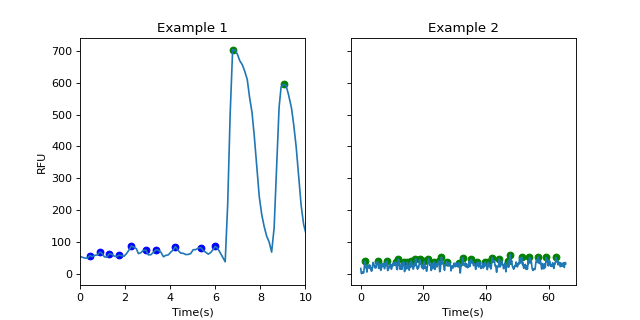
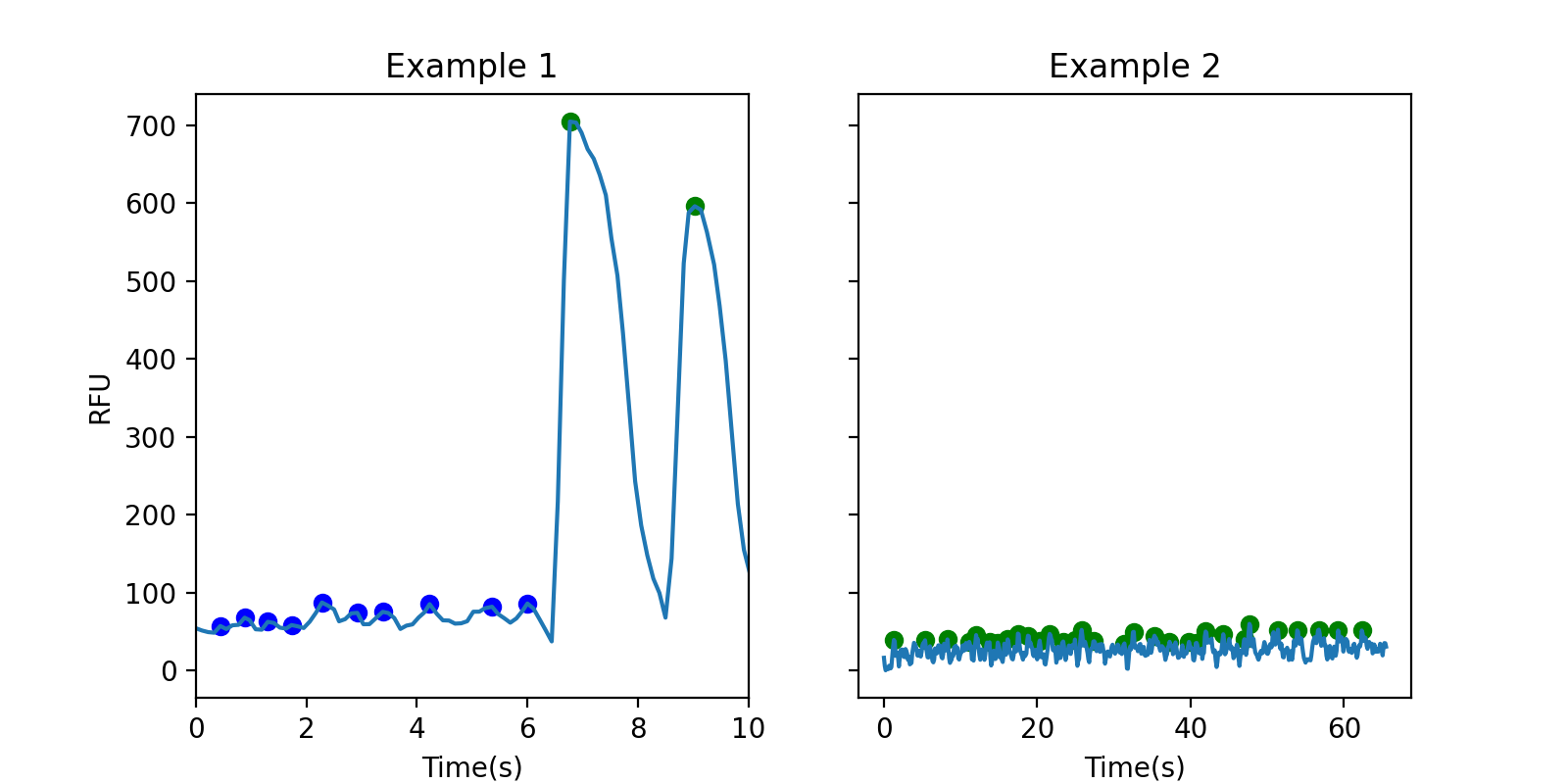
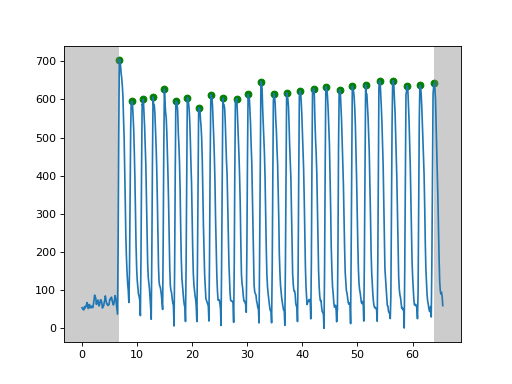
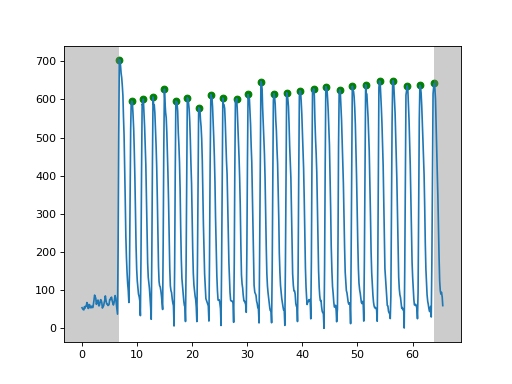
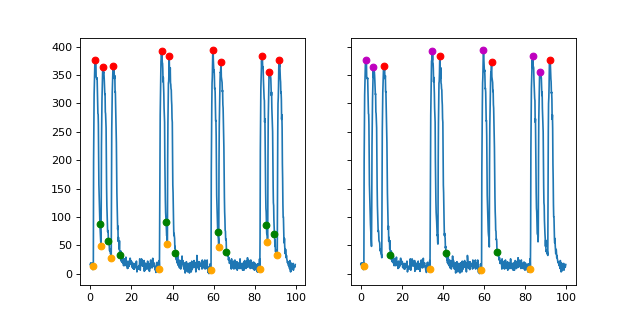
In the left example, the peaks before 6s are all false peaks (red points), which may caused by noises. Their prominences are all lower than 10% of the highest itensity. The green points are real points as their prominences are far higher than the threshold.
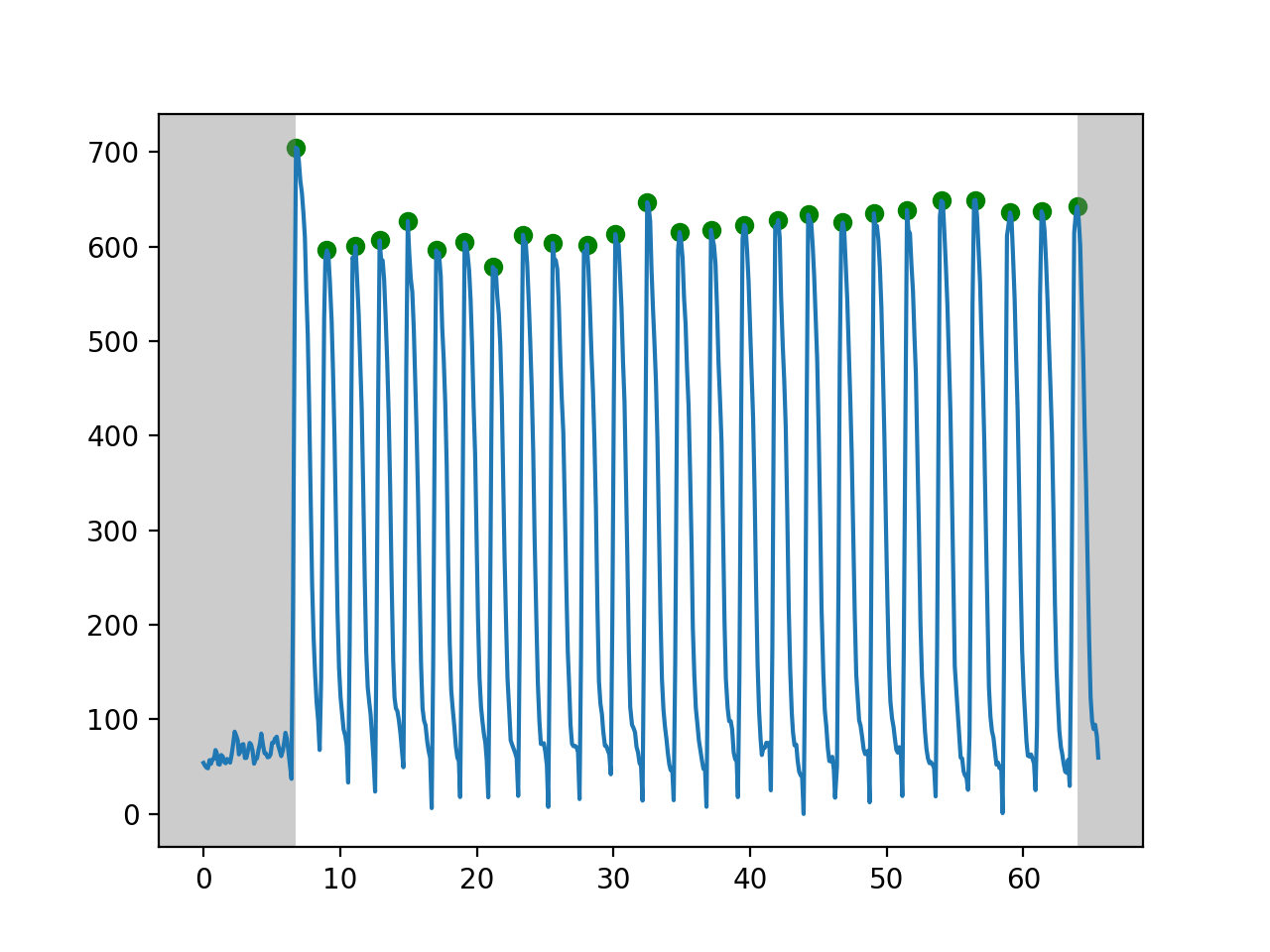
In the right example, althrough these peaks are real in terms of the pre-set rule of prominence higher than 0.1 * span, we know that they are actually false peaks as their signals are very low compared to the left example. However, CardioWave does not know that. So, one potential solution is to manually set the threshold by get_peak(prominence=100), where the threshold 100 depends on the data we have. We can set the threshold according to positive control.
How are the parameters derived
Firstly, peak detection is implemented to separate the waveforms into individual wave cycles, from which single wave cycle parameters such as duration and amplitude can be calculated.
For each cycle of a waveform, parameters can be derived according to the key time points, including the rising point (the first point of a cycle), peak point (maximum of a cycle), tail starting point (the first point lower to 10% of maximum during decay) and valley point (the lowest point in a cycle).
See Derive parameters using a customed calculator to know how these steps are implemented.
Frequency and amplitude realted parameters
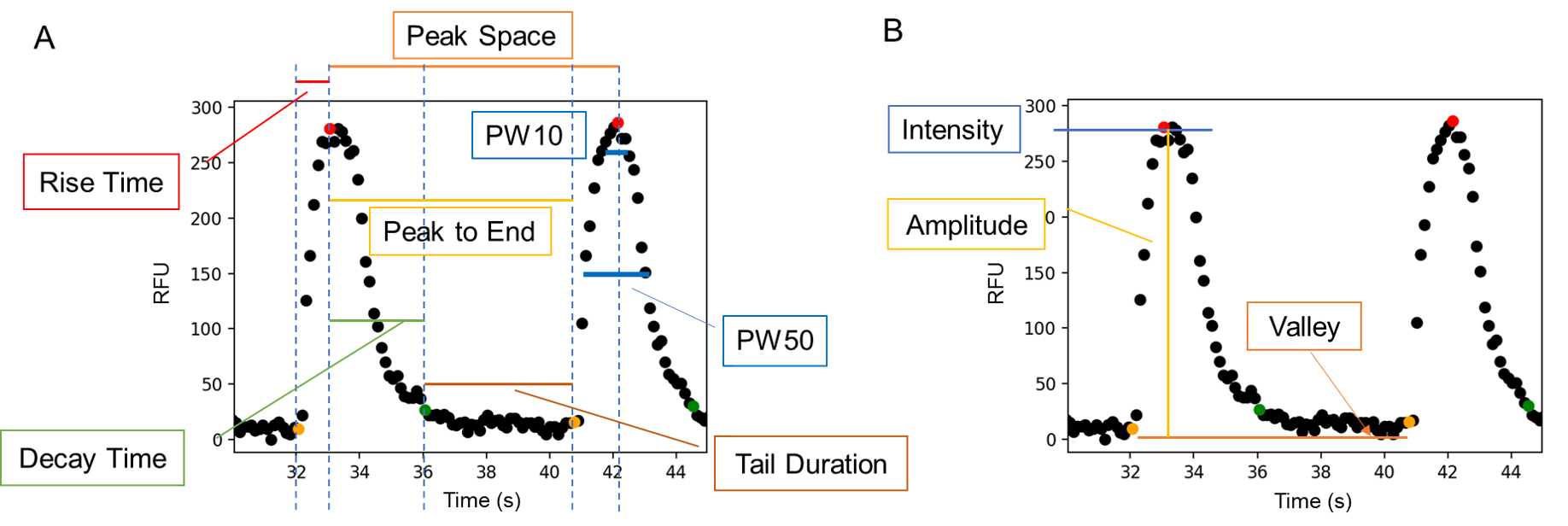
As shown in the figure on the left, the starting points are coloured in orange, tail starting points in green and peak points in red. A cycle starts from a peak point to next one. The duration between two peak points is Peak Space. Rise time is the duration between the starting point and peak point. Decay time is the duration between a peak point and the corresponding tail starting point in the cycle. Peak to End is the duration between the peak point and the starting. Althrough the starting point is for the next peak, we say this starting point as it belongs to this cycle.
The figure on the right shows the definitions of the amplitude-related parameters. Intensity is the absolute RFU value of the peak point, while amplitude this the vertical distance between the peak point and the valley point.
Shoulder-tail related parameters
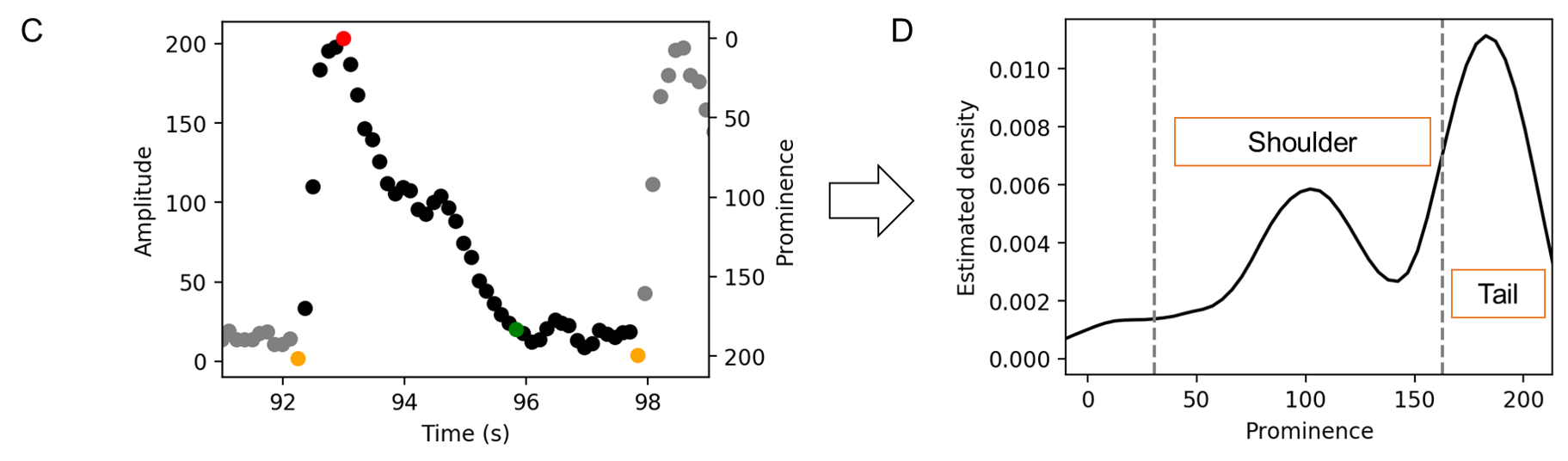
Shoulder-tail related parameters are novel parameters in this tool. This was inspired by the findings that some waveforms have a shoulder-like, when the peak space is higher than a normal one (e.g. from DMSO).
Univariate kernel density estimation is used to derive shoulder-related parameters. The Biweight kernel is used and the bandwidth was set to 0.2 times of peak amplitude. In the density distribution, the peak of which the prominence (x axis) is between 0.15 and 0.8 times of maximum was regarded as shoulder, and prominence higher than 0.8 times of maximum was regarded as the tail. Then shoulder position (ratio to the prominence of the peak) and the Shoulder/Tail are recorded as the parameters of this cycle. To avoid extremely high values when tail density was close to 0, the maximum Shoulder/Tail is set to 2.5.
Aggregate the parameters of all cyles
After the parameters of cycle has been calculated, statistical parameters such as mean, standard deviation, and maximum were used to describe the whole waveform. The following is an example of how average peak amplitude and standard deviation of peak amplitude are calculated.
where i is the number of cycle and PA means peak amplitude
When Aggregating the parameters of all cycles, the first group (signals before the first peak of the whole waveform) and the last group (signals after the last peak of the whole waveform) will not be used as they are not entire cycle.
(Source code, png, hires.png, pdf)
Peak and subpeak detection
Peak detection is implemented attempting to get the cycle number of each signal and to derive parameters from each cycle. With default setting, peaks of which the prominence is lower than 20 or 10% of the Maximum Amplitude of the waveform would be regarded as a “false peak”, which means the peak will not be regarded as a peak in the following analysis. For the boundary of the waveform (the first and the last peaks), the prominences lie on the inner side of the peaks, i.e. the leftmost peak bases only on the right side of the peak to measure the prominence.
Two approaches are used to identify multi-peaks, prominence-based and tail-based. In the prominence-based approach, if the prominence of a peak is lower than a threshold, and signal or amplitude is close to the last real peak within 10% of the maximum amplitude (MA), the peak will be regarded as a double peak or a subpeak. The threshold is determined empirically to be 50% of the maximum prominence (MP) when MA is lower than 250, and 70% of MP when MA is higher than 250.
In some situations, the prominence-based approach cannot identify multi-peaks well. Based on our finding that cycles end with a long tail but the subpeaks don’t, we recognised the subpeaks by comparing their tail with the maximum tail length in the waveform.
(Source code, png, hires.png, pdf)
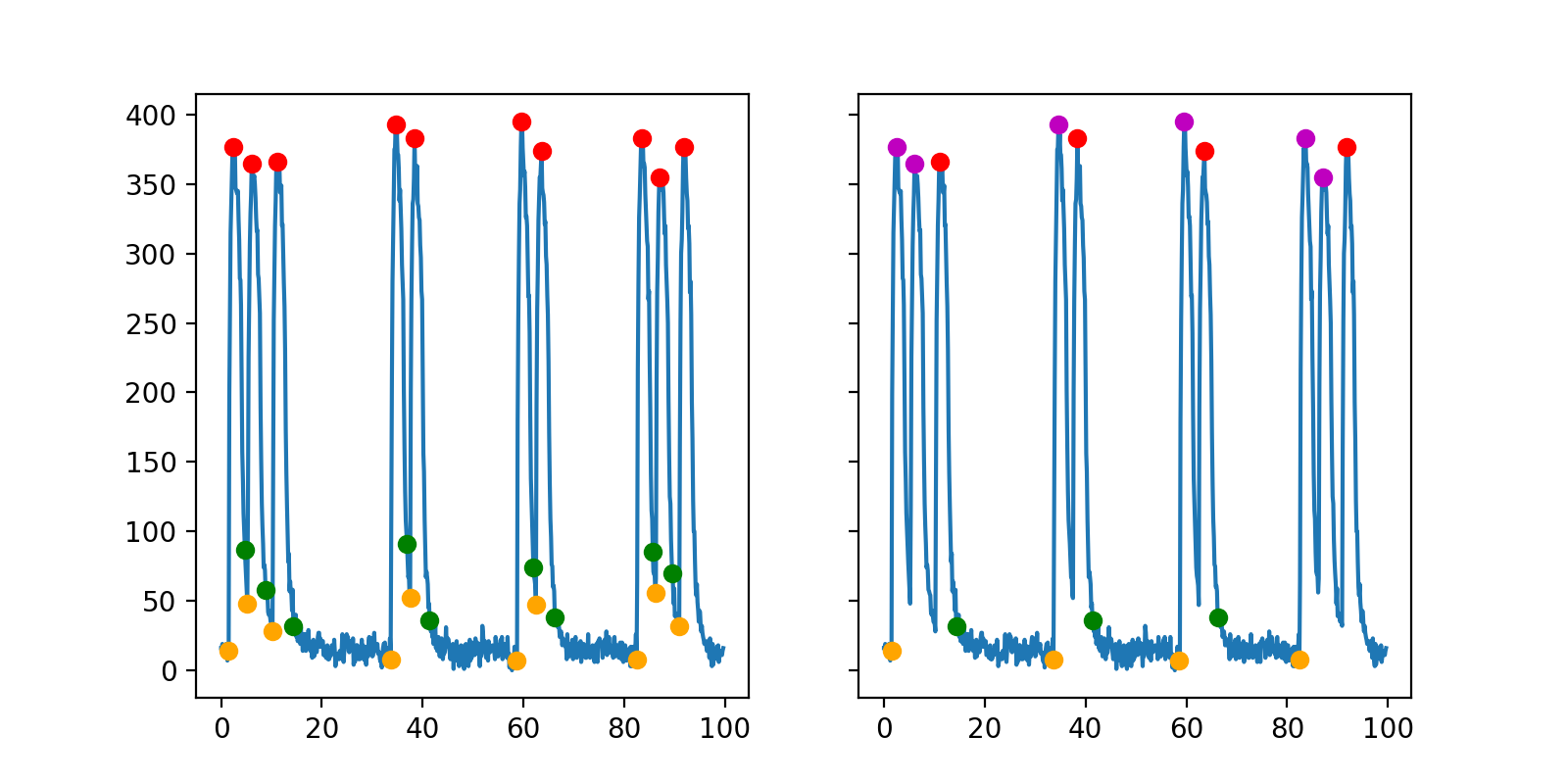
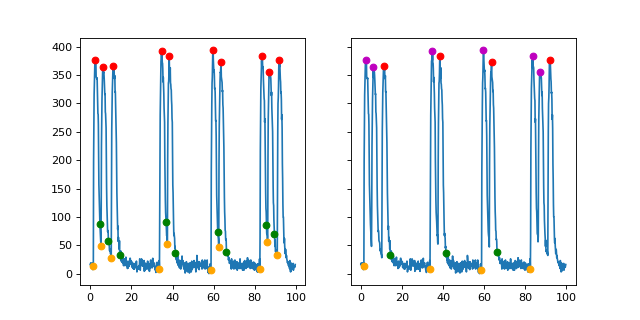
The figure on the left show the original recognitions of the key time points. The orange are starting points and the green are decay points. Tail duration is calculated by \(starting\ point - decay\ point\).
The duration of the tails are 0.5, 1.37, 19.31, 0.62, 17.2, 0.5, 16.22, 0.5, 1.38 The average tail duration is 6.4 and the standard deviation is 8. We can see that the standard deviation is more than half of the average, which means there are double peaks. If the tail duration is lower than \(Max(tails) - \sigma (tails)\), it is regarded as a short tail and the corresponding peak is marked as a sub-peak. Otherwise, when the tail duration is within the standard deviation, it will be regarded as a real peak. After the adjustion, now there are only four peaks (red points) and the others are sub-peaks (Megenta points in figure on the right).
Note
For waveforms with multi-peaks, the parameters are imprecise. For example, as shown in the figure on the right, the rise time will be the duration between the red point and the orange, which is larger than we thought. Theratically we can fix it by calculatingthe duration between the first sub-peak and the starting point. But it is not implemented yet as we don’t use the samples with multi-peaks.
Process the parameters
After deriving the parameters, we will get a dataframe (parameter_df) like
the following table. The the compound name of vehicle control is supposed to be
DMSO.
compound |
concentration |
well |
plate |
..parameters.. |
|---|---|---|---|---|
CP1 |
0.1 |
A1 |
P1 |
… |
CP1 |
0.5 |
A2 |
P1 |
… |
… |
… |
… |
… |
… |
DMSO |
A5 |
P1 |
… |
|
… |
… |
… |
… |
… |
Quality control and Normalisation
The parameters cannot be used directly because of batch effects and variance of cells. We need to do quality control to remove samples with low quality and normalise the parameters based on pre-measurement and/or vehicle control.
Quality control can be implemented by remove_low_quality.
Wells of a plate will be removed if:
Double peak in negative control
High standard deviation of peak space in negative control
Low quality in baseline.
For any case of the following critera, the well will be removed due to the low quality of baseline:
There is at least one multi-peak
standard deviation of peak space is higher than 1
maximum amplitude is lower than 100
Some key time point (such as decay point) cannot be recognised
Then RCV will be calculated from the DMSO samples of each plate
If RCV >= 0.2, the whole plate will be removed.
Normalisation can be done by normalise_by_baseline and normalise_by_negctrl.
Normally we have two ways to normalise the parameters. For value types such as peak frequency, we suggest using subtraction and division, while for ratio type and deviation type, we suggest subtraction only.
If we don’t have baseline data, then we can use the median value of DMSO.
if we have the baseline, we need to normalise again to avoid batch effect.
If we have baseline waveforms, the suggest workflow is like the following.
from cdwave import param

value_parameters = ['freq', 'avg_amplitude', 'PW10_mean']
ratio_parameters = ['shoulder_tail_ratio']
std_parameters = ['std_amplitude', 'PW10_std']
subtract_parameters = ratio_parameters + std_parameters
divide_parameters = value_parameters
all_parameters = subtract_parameters + divide_parameters

parameter_df = dataset.get_parameter_df() # Get parameters
parameter_df, removed_wells = param.remove_low_quality(parameter_df)
norm_df = param.normalise_by_baseline(
    parameter_df, subtract_parameters, divide_parameters)
norm_df = param.normalise_by_negctrl(
    parameter_df, 'sm', parameters=all_parameters)
If baseline is not available, we need to normalise by negative control.
standardiser = {'sdm': divide_parameters, 'sm': subtract_parameters}
norm_df = param.normalise_by_negctrl(parameter_df, standardiser)
Derive IC50 values
After deriving parameters of the waveforms, we can then derive IC50 values by analysing the concentration response.
ToxCast Pipeline (TCPL) is implemented. Three curves will be fitted:
Hill model
Gain-Loss model
Constant model
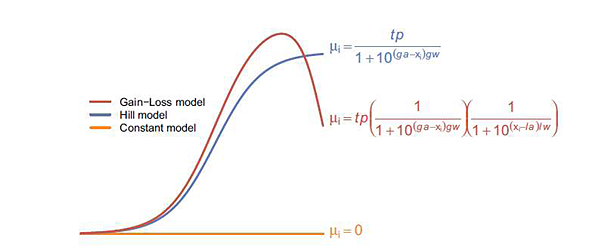
Different from TCPL, CardioWave use the following equation to fit Gain-Loss model, considering that the parameter would increase from 0 and then reduce to a negative value.
The following is an example of how to derive IC50 of peak frequency for Aspirin.
from cdwave import hillcurve
# norm_df is normalised parameters. See previous section
compound = 'Aspirin'
dmso_df = norm_df[norm_df['compound'] == 'DMSO']
cmp_df = norm_df[norm_df['compound'] == compound]
conc, resp = cmp_df.concentration, cmp_df['freq']
for fnc in [hillcurve.TCPLHill, hillcurve.TCPLGainLoss, hillcurve.TCPLPlain]:
    try:
        curves.append(fnc(conc, resp))
    except Exception as e:
        pass
# Plot figure
fig, ax = plt.subplots()
# You may also need to check whether there is no curve
cc = np.arange(curves[0].c_min, curves[0].c_max, 0.01)
for curve in curves:
    label = '{}-{:.2f}'.format(type(curve).__name__, curve.EC50())
    fnc = np.vectorize(curve.predict)
    ax.plot(cc, fnc(cc), label=label)
ax.plot(curve.concentrations, curve.responses, 'o', label='Response')
# Get noise band
s = dmso_df['freq'].replace(np.inf, np.nan)
band = s.dropna().std()
ax.fill_between(cc, -band, band, hatch='////', alpha=0.4,
                edgecolor='green', linewidth=0, facecolor='white')
AIC (Akaike information criterion) can be used to evaluate which model is better in fitting the concentration response. RSS (residual sum of squares) is used as the likelihood function. K is the number of estimated parameters.